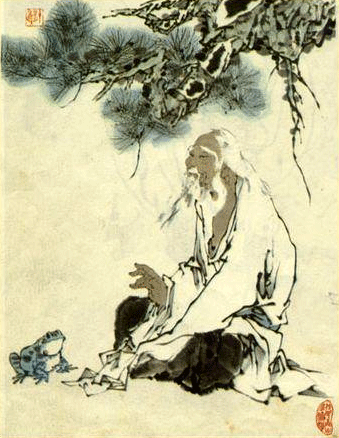
Trusting the Inner Vision: A Journey Through Chuang Tzu's Wisdom
Chuang Tzu's assertion that "the master observes the world but trusts his inner vision" invites us to reflect on the delicate balance between external observation and internal insight. In a world often dominated by noise and distraction, this quote serves as a reminder of the importance of cultivating a deep, personal understanding of truth. It suggests that while we may engage with the world around us, our true wisdom arises from within, guiding us through the complexities of life.
This teaching resonates profoundly in our contemporary lives, where external validation frequently overshadows our inner knowing. Chuang Tzu encourages us to cultivate a relationship with our inner selves, suggesting that true mastery comes not from mere observation but from a profound trust in our intuition and inner wisdom. This journey inward is essential for navigating the challenges of existence, allowing us to discern what is genuinely meaningful amidst the chaos of the external world.
The image / the metaphor
The imagery in Chuang Tzu's quote evokes a masterful figure, one who stands apart from the tumult of the world yet remains acutely aware of its nuances. The act of "observing" implies a careful, deliberate engagement with the environment, suggesting that the master is not detached but rather deeply present. The phrase "trusts his inner vision" introduces a sense of intimacy with one's own understanding, highlighting the importance of inner clarity and conviction in the face of external distractions.
In the speaker's tradition
Chuang Tzu's teachings are deeply embedded in the Taoist tradition, which emphasizes the importance of aligning oneself with the natural flow of the universe, or the Tao. Central to this philosophy is the concept of "wu wei," or effortless action, which encourages individuals to act in harmony with their inner nature rather than through forceful striving. This aligns closely with the idea of trusting one's inner vision, as it suggests that true wisdom arises when we allow ourselves to be guided by our innate understanding rather than external pressures.
In the text of the Zhuangzi, we find numerous anecdotes illustrating the importance of inner wisdom and the folly of relying solely on external validation. For instance, the story of the "butterfly dream" invites readers to question the nature of reality and perception, suggesting that our understanding of the world is often clouded by our attachments and desires. This narrative echoes the sentiment of Chuang Tzu's quote, reinforcing the idea that true mastery lies in the ability to discern one's inner truth amidst the illusions of the external world.
Living the teaching
Consider a modern scenario where an individual faces a significant career decision. The pressure to conform to societal expectations and the opinions of others can be overwhelming. In such moments, Chuang Tzu's teaching serves as a guiding light, encouraging the individual to pause and reflect on their inner vision. By tuning into their intuition and personal values, they can navigate the complexities of their choices with greater clarity and confidence, ultimately leading to a more authentic path.
In the realm of relationships, this teaching can manifest in moments of conflict or misunderstanding. When faced with a disagreement, one might be tempted to react impulsively based on external cues or emotional triggers. However, by embodying the wisdom of Chuang Tzu, individuals can take a step back, observe the situation, and trust their inner vision to guide their responses. This practice fosters deeper understanding and connection, allowing for resolution that honors both parties' truths.
A reflection
As we contemplate Chuang Tzu's profound insight, we are invited to examine the ways in which we engage with the world around us. How often do we allow external influences to overshadow our inner knowing? In what areas of our lives can we cultivate a deeper trust in our intuition? Reflecting on these questions can illuminate the path toward greater wisdom and presence, guiding us toward a more authentic existence.



Join the BrightStar Community
Stay connected with daily inspiration, event announcements, and community wisdom